It’s already been a year since Slimbook OS was officially released. It’s true that a few months earlier we already had a pilot based on Gnome Shell, but we wanted to offer the two major desktops, and that took us a bit more time.
Including two different desktops in a single ISO without making the size enormous was a challenge. Using KDE Neon to provide the Plasma desktop was another added challenge. KDE Neon is a fantastic project—it offers the public a rolling-release of the Plasma desktop built on top of Ubuntu LTS. For us, this was a moving target: two distributions in one image, where one of them is updated quite frequently and, on top of that, we apply our own branding.
It was a challenge, but make no mistake, we are convinced it was the best option. It seems that many changes have recently taken place in the KDE Neon team, and we still don’t know if we will continue to rely on this project to build the upcoming Slimbook OS 26. Either way, we want to include Plasma.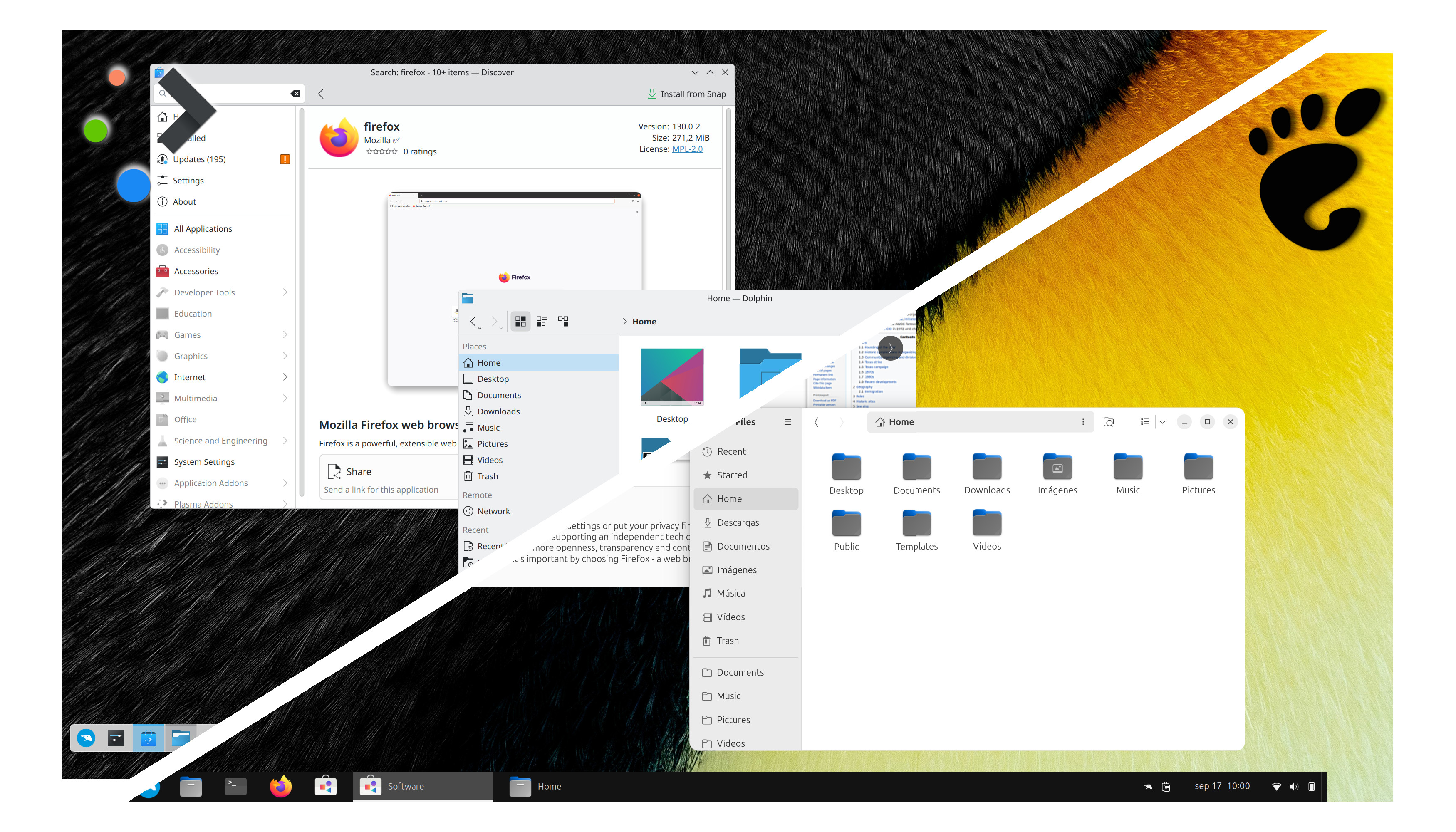 What’s the point of creating this distribution? Well, there are several factors that motivated this. The key factor is having our software pre-installed, especially the drivers, but also our services and configuration tools. We have modified the installer so that it detects the model we are installing on and selects only the strictly necessary drivers. This greatly streamlines the installation process, and we can forget about adding repositories, keys, installing headers, etc.
Having our own distribution allows us better control over the software offered. Obviously, in the base installation we have already selected the software and extensions that provide the experience we want to deliver. But we can go further. For example, we were clear that the experience of the natively packaged Firefox is still better than the Snap version. Slimbook OS blocks the version offered by Ubuntu and instead provides Firefox directly from Mozilla’s repository.
Although a lot of progress has been made in recent years with platforms for delivering software, a customized distribution remains a very powerful tool to offer a finely tuned product. For those concerned about security, Slimbook OS has Ubuntu repositories enabled, including update and security ones, so security is not compromised with us.
What can we improve? Believe it or not, we know that the ISO can still be further compacted! We have some ideas to recover some poorly optimized space and perhaps use it to include more software. We are even considering that the installation be carried out package by package (as is done in Debian), instead of installing by copying, as is common in Ubuntu-based distributions. Admittedly, this would make installation somewhat slower, but more customizable.
It’s still a bit early to announce what the next Slimbook OS will look like, we have a lot to analyze.
